

The Spell "Weapons" Casts on Big Tech
Zach Cregger’s latest horror feast hides a parable about algorithms, control, and the unseen forces shaping our behavior.

The mystery around director Zach Cregger’s horror hit Weapons catapulted it to number one at the box office last weekend, earning the New Line Cinema and Warner Bros. release $43.5 million. That’s a massive increase from Cregger’s previous cult horror hit, Barbarian, about a terrifying Airbnb rental hidden in the slums of Detroit, which earned $10.5 million for its opening weekend.
So, what is Weapons about? Well, aside from the comically creepy Naruto-style running children, that is a secret best left revealed in the chapters that gradually unfurl during the film. But if you are here, I’m assuming you’ve already seen Weapons and are wondering, “What the hell did I just watch?” Well, about that…
The secret plot in Weapons is supposed to be about horror. But in truth, what Cregger did was deftly weave a tapestry of social commentary into a film presumably about — Spoilers Ahead — a town gradually and surreptitiously captured and abused by one clever witch hiding in plain sight. And that’s what I thought it was about, too, at first.
But then something struck me: Why, in a film centered on schoolchildren in 2025, do we never see a single child holding a smartphone? Or an iPad? Or even plop down in front of a computer? We know the film is contemporary because the schoolteacher, Justine (played by Julia Garner), reads smartphone texts during the movie. We also know we’re in modern times because Ring cameras are featured prominently in the plot, as parents attempt to discover why their children have run off in the middle of the night.
The odd absence of technology in the hands of normally tech-obsessed 2025 children was curious. But the final clue that confirmed “something about tech” was amiss is the scene where Alex (played by Cary Christopher), the last remaining child from the class of disappeared children, is at home in bed. In the flashback moment, Alex is shown sneaking to read a book at night using…a flashlight? While holding…a paper book? That’s very 1980s of Alex, even if he is a budding young bookworm. No iPad tablet. No smartphone. I think the absence of technology in the hands of children in Weapons was deliberate. I’ll explain, but first, a bit of semiotics unpacking.
Magic Meets Metadata
A central theme in Weapons is the witch Gladys’ (brilliantly played by Amy Madigan) need to obtain a personal item of the person she wants to control through her spells. Known as a taglock in witchcraft, these personal items are thought to give a spellcaster a personal connection to a target, making it easier to control their behavior, and thus, their fate.
It’s an old trope familiar to many forms of witchcraft around the world. Yet in Weapons, the dynamic takes on added meaning, particularly given what we now know about Cregger’s decision to erase technology from the children’s framework.
This idea of using items belonging to a person to influence their behavior is an ingenious metaphor for how our online interests are used to feed algorithms, which then determine how to influence us toward distinct silos of interests, products, and even actions. In the real world, our taglocks are our Internet cookies and browsing routines.
And through this lens, technology companies are, well, the witches, casting spells behind the sleek, opaque interface of their software. The algorithm cannot influence your behavior unless it has a piece of you—a hard data point that indicates your obsessions and even casual interests. Only then can it begin casting its eldritch spells.
Pattern Recognition
Cregger is a new breed of horror auteur in that he is organically immersing his story in the milieu of digital culture, one way or another. In the same way that Barbarians was undergirded by the plot device of an Airbnb app interaction gone wrong, Weapons is, I believe, about how we are susceptible to unseen forces that have the ability to control us, as long as they know just a bit about us. And when that control is exerted, it can result in real-world actions, both good and bad. Weapons is about control. Remote control. And how, today, we often don’t even know that we’re being remotely controlled, or how.
My suspicion around Cregger’s messagey intent coalesced into cautious certitude during Archer’s (played by Josh Brolin) dream sequence. Archer visualizes an AR-15 semi-automatic rifle in the night sky alongside the number “2:17,” the time during which all the children disappeared. Up until that moment, I was completely mesmerized by Weapons.
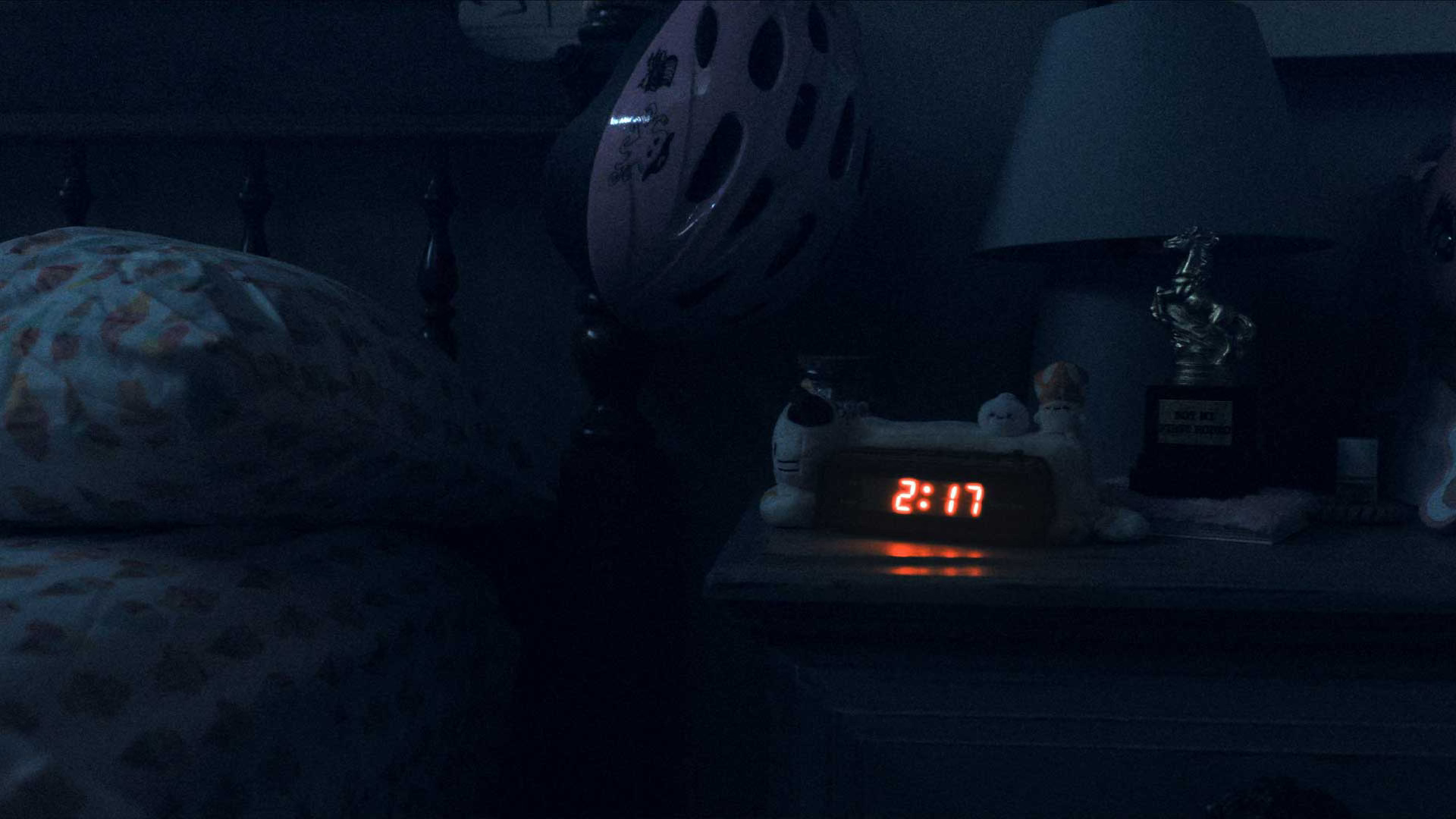
The sudden appearance of gun imagery jarred—an off note in an otherwise mellifluous dark composition.
In the context of the film, the gun didn’t add up for me. That is, until I broke out the conspiracy red yarn for the wall map and newspaper clippings, and discovered a startling coincidence that defies mere happenstance. In 2022, driven by the recent spate of mass shooting gun violence in the U.S., the House of Representatives passed the Assault Weapons Ban (H.R. 1808) by a 217 to 213 vote, a bill that later stalled and died in the Senate. 217, indeed. (Theologians might be tempted to link the number to the Bible’s Matthew 2:17 and the slaughter of children, which is also plausible in this case.) That legislative attempt harkened back to the late ‘90s, when U.S. Attorney General Janet Reno, in an effort to protect children, sought to link the proliferation of violent speech, games, and movies to violent behavior.
No one, as far as I know, behind the film has admitted to any connection between Cregger’s 2:17 gun imagery and the historic governmental action of 2022. But when paired with the gun imagery and the glaring absence of social media tech tools among the schoolchildren in Weapons, the real message of the film begins to emerge from the inky hues of the cinematography and comes into focus with startling clarity. Cregger seems to be saying: Children are being influenced by an unseen hand in our real world, and it could lead to dangerous outcomes.
Weapons of Mass Seduction
One of the usual suspects often tagged as an underestimated cultural contagion is social media. The debate around social media’s influence on children is ongoing. A recent study published in PNAS Nexus, a peer-reviewed journal from the National Academy of Sciences, found that, “[Twitter’s] engagement-based algorithm significantly amplified tweets that expressed negative emotions—anger, sadness, and anxiety. It also led readers to feel more of all [these] emotions.” The study goes on to assert that, “In the context of modern social media, exploiting biases can lead to heightened social misperception and conflict.”
Translation: Social media is the vector through which humans are often emotionally impacted, and sometimes…weaponized.
The recent documentary Can't Look Away: The Case Against Social Media, directed by Matthew O’Neill and Perri Peltz, tackles the topic more directly, and without the artistic flair of Weapons, but both films seem to resonate along the same frequency of warning.
Children (digital consumers) may eventually turn on the witch (Big Tech). And all it might take is an Alex (a hacker) to turn the algorithm against its former masters.
Ultimately, if we take Weapons’ metaphor to its logical conclusion, the inference is that children (digital consumers) may eventually turn on the witch (Big Tech). And all it might take is an Alex (a hacker) to turn the algorithm against its former masters. This delicate dance will become even more strained as AI chatbots work to befriend us. How, in the coming months and years, will Section 230, which protects tech companies from liability for the content they distribute, deal with AI chatbots that guide a person toward a particular outcome? Ideas are being discussed, and legal filings have been in play, but nothing in the larger scheme of things is settled yet.
Weapons reminds me of one of my favorite quotes from science fiction giant Arthur C. Clarke, “Any sufficiently advanced technology is indistinguishable from magic.” Nothing has been treated like “magic” by the public more than AI. In that respect, Cregger’s film is quite like a subtly crafted Ouija board séance, in which the spirits of the characters are urging us to consider who will wield the spells of technological influence, while simultaneously telling us that we must, no matter what, hold the Big Tech witches accountable.